
Wolverine Stack: BPC-157 + TB-500 — Does It Really Work?
Quick answer: The "Wolverine stack" is internet shorthand for a peptide combo built around BPC-157 and TB-500 (often with GHK-Cu added for skin and collagen). It's marketed for fast injury recovery, but the honest picture is messier: the human evidence is thin and mostly preclinical, neither peptide is FDA-approved, both are banned in competitive sport, and product quality on the gray market is wildly inconsistent. If it helps at all, it likely helps as a supporting player to real rehab — not as a shortcut around it.
Here's the tension in one line: the mechanisms look interesting, the anecdotes are loud, and the actual clinical proof is quiet. This guide walks the line between those three without selling you anything.
What is the Wolverine stack?
A lot of people hear "Wolverine stack" and picture a legal cheat code: inject a couple of peptides, wake up two days later, and your tendon is brand new. Reality is far less cinematic.
The Wolverine stack is a nickname — borrowed from the comic-book character's regenerative healing — for a peptide stack combining three tools whose goals rhyme: calm inflammation, support tissue repair, and get back to training without feeling like your body is made of wet cardboard.
The combo usually breaks down like this:
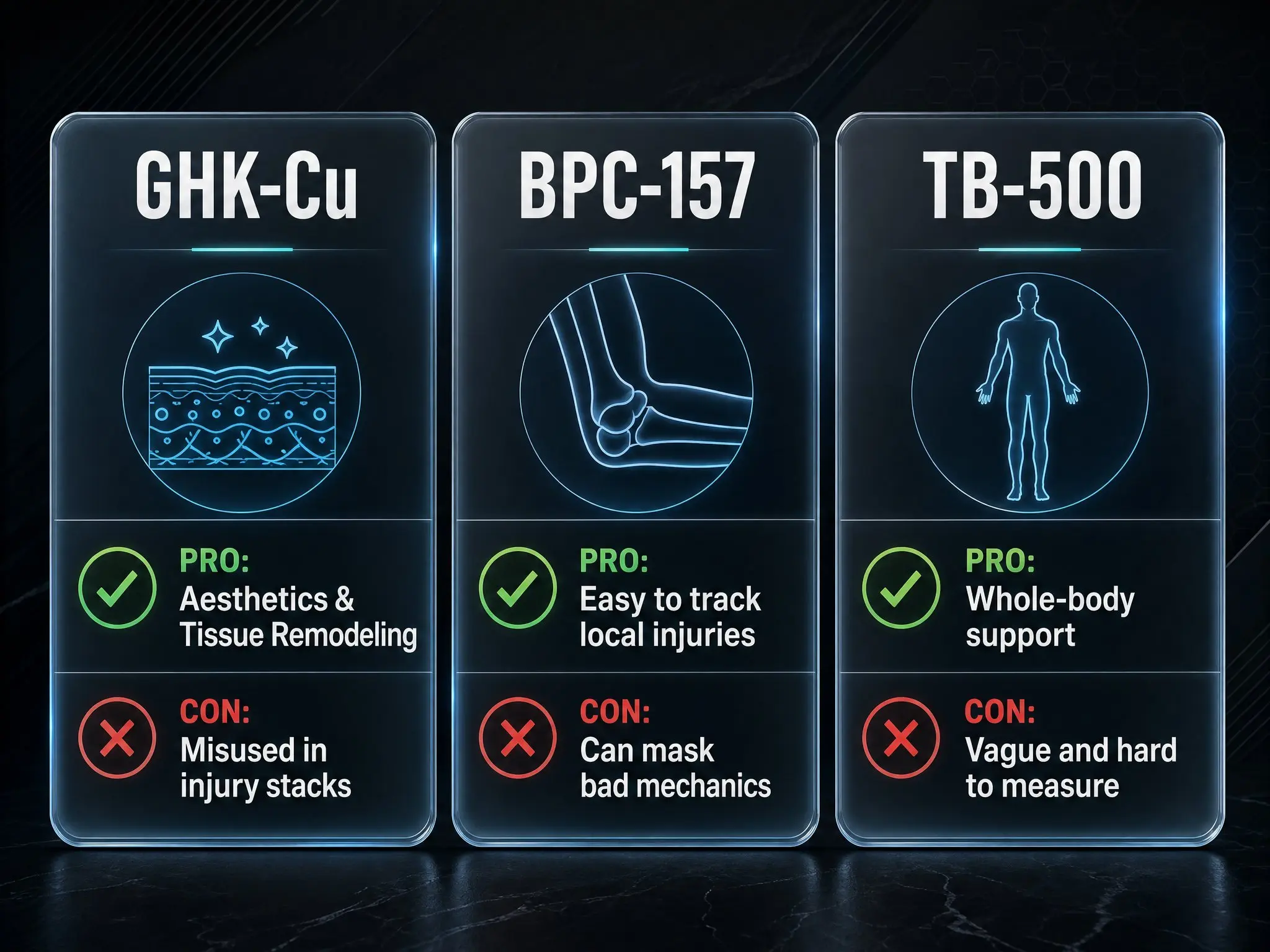
- BPC-157 (body protection compound 157): aimed at tendons, ligaments, gut irritation, and stubborn soft-tissue injuries.
- TB-500 (a thymosin beta-4–related fragment): aimed at muscle-strain recovery, mobility, and general tissue remodeling. See how TB-500 works for the full mechanism.
- GHK-Cu (copper peptide): aimed at skin texture, wound appearance, and collagen signaling — sometimes hair. More on GHK-Cu, the copper peptide.
That's the stack. People love the simplicity. Bodies do not care about your marketing.
The "Wolverine" branding is mostly internet rehab culture turning into sales copy — and once you notice it, you can't unsee it on most vendor pages. That doesn't mean everyone chasing recovery is imagining results. It means the real signal, if it exists, is probably smaller, messier, and far more dependent on the rest of your treatment plan than the hype admits.
What's actually in the combo?
BPC-157
BPC-157 is a synthetic pentadecapeptide (15 amino acids) originally studied in animal models. The lore centers on connective tissue, low-blood-flow tissue, and "stubborn" injuries where remodeling is slow. In peptide-therapy circles it's the one treated like a repair peptide with opinions about everything.
TB-500
Here's where confusion starts. Thymosin beta-4 is a naturally occurring peptide involved in actin dynamics and cell movement. TB-500 is typically marketed as a shorter, lab-made version meant to capture some of those effects — so it is not the same molecule as thymosin beta-4, despite constant conflation. In practice, TB-500 talk is almost always about generalized recovery, not one specific injury.
GHK-Cu
GHK-Cu is the oddball, in a good way. It has real visibility in dermatology and cosmetic research — often used topically, sometimes injectable in clinical settings. It shows up in the stack because people chasing "regenerative" outcomes usually also want their skin to look less tired while they heal.
| Component | Common intent | Where the evidence is strongest | Usual form people talk about |
|---|---|---|---|
| BPC-157 | Tendon, ligament, inflammation, gut irritation | Preclinical mechanistic + animal data | Subcutaneous injection; oral capsules discussed |
| TB-500 | Muscle recovery, tissue remodeling | Mechanistic + preclinical work tied to thymosin pathways | Subcutaneous injection |
| GHK-Cu | Collagen, skin health, wound appearance | Skin biology; topical + mechanistic data | Topical serum/cream; sometimes injection |
How does each peptide work?
The proposed mechanisms are the most legitimately interesting part of this story.
BPC-157 gets described in terms of angiogenesis (new blood-vessel growth), nitric-oxide signaling, and connective-matrix remodeling — plus deeper pathways like focal-adhesion and cytoskeletal signaling covered in open-access soft-tissue repair reviews.
TB-500 and thymosin beta-4 discussions lean into actin polymerization, cell migration, and progenitor-cell recruitment. The short version: help cells move and organize so repair can happen — which is why thymosin shows up in wound and tissue-injury models.
GHK-Cu is all about extracellular-matrix tone: collagen, elastin, glycosaminoglycans, and the enzyme systems that build and break them down. That skin-facing research is summarized in clinical and mechanistic reviews.
Interesting mechanisms are not the same as proven human outcomes, though. Keep reading.
What does the evidence actually say?
Here's where people get mad — but it's the honest framing. The strongest "evidence" cited for the Wolverine stack is a mix of preclinical studies, mechanistic plausibility, and a mountain of anecdotes that read like sports-injury confessionals.
- BPC-157: preclinical wound and tissue-repair work showing early gene-expression and wound-resolution signals (e.g., the EGR-1/NAB2 loop), plus vascular and thrombosis-related animal data.
- TB-500 / thymosin derivatives: evidence around fibrosis modulation and anti-scarring behavior — which matters, because scar tissue is not the same as functional tissue.
- GHK-Cu: the base is more "skin biology" than "your rotator cuff" — metalloproteinases, collagen synthesis, fibroblast activity, discussed in matrix-focused reviews.
Then there's the clinical gap, and it's a canyon. Orthopedic literature has been blunt that human musculoskeletal trials for these injectables are limited. Independent evaluators go further: there are no large-scale, randomized, placebo-controlled human trials proving BPC-157 works, and consumer-health watchdogs note that neither BPC-157 nor TB-500 can legally be sold as a dietary supplement in the U.S. — with Canada actively advising consumers to avoid them.
What remains genuinely unknown
Human dose-response for specific injuries: not nailed down. Long-term safety: not nailed down. Gray-market product purity: absolutely not nailed down.
Even the results talk is shaky. In the same community thread you'll find one person calling it miraculous and the next saying nothing happened. That spread isn't a footnote — that spread is the story.
When do people use the Wolverine stack?
Tendon and ligament pain
Tendons and ligaments are slow and moody. People don't just want less pain — they want capacity back: the ability to load without the tendon screaming like a smoke alarm.
So BPC-157 + TB-500 tends to get used during rehab blocks, alongside graded loading and symptom tracking. When people claim "accelerated tendon healing," part of what they may really be experiencing is better training tolerance — they stop flaring it up, move more confidently, and inflammation settles. After weeks of being stuck, that can feel like magic. It isn't proof of new tissue.
Muscle strain recovery
TB-500 talk is heavily muscle-centric, and a lot of it reads like "I pulled something and I'm tired of waiting." The catch: muscle often improves quickly on its own, so the attribution problem is huge. If you start a stack the same week you finally stop sprinting on a strain — what actually healed you?
Skin and hair support
GHK-Cu is the "skin lane" add-on: texture changes, post-procedure support, sometimes hair. Clinically you'll see topical use more often than injection, because it's a simpler risk profile and the target tissue is literally the surface.
What benefits are most reported?
The most common real-world report is "I felt less achey" — not "my MRI grew a new tendon." Pain shifts first because pain is a perception shaped by inflammation, nervous-system sensitivity, movement fear, sleep, and stress. That's not dismissive; pain relief is meaningful. It's just not evidence of tissue regeneration.
The most believable win is improved training tolerance: you handle eccentrics, stop guarding, add load without spiraling. In injury recovery that's a big deal, because consistent mechanical load is what tissue actually responds to. With GHK-Cu, people report smoother skin texture and faster-looking recovery after irritation — directionally consistent with what the compound is known for, even if online expectations get a little unhinged.
How do protocols usually look?
This is where online "protocol" talk gets dangerously confident — and confidence is not clinical data. This section describes the pattern people report; it is not a dosing guide and not medical advice.
In practice, self-directed protocols tend to be phase-based: a short "loading" period, a maintenance period, then a break. Delivery is usually subcutaneous. Some clinics run supervised protocols with compounded products, but availability and legality vary and are shifting fast under FDA scrutiny of peptide access. GHK-Cu for skin is usually topical and daily; for tendons, topical is mostly wishful thinking.
On dosing specifically: you'll find a hundred conflicting "BPC-157 dosage" charts online, and this guide won't add a hundred-and-first. The honest takeaway isn't a number — it's that any therapy this poorly standardized should, at minimum, be started low, monitored closely, and adjusted, ideally under a clinician who can screen you first.
A typical cycling structure people describe:
| Phase | What people report doing | Goal |
|---|---|---|
| Early | Introduce one compound first, then add the second | Isolate tolerance and side effects |
| Middle | Run the stack consistently while rehab load increases | Support recovery, not replace it |
| Later | Taper or stop, then reassess | Avoid endless use; check whether gains actually hold |
Not medical advice. Just the pattern.
How to reduce risk before you try it
If you take one thing from this article, take this: the biggest risks aren't "you picked the wrong peptide." They're contamination, dosing slop, and ignoring red flags because you're desperate to train.
Side effects and red flags
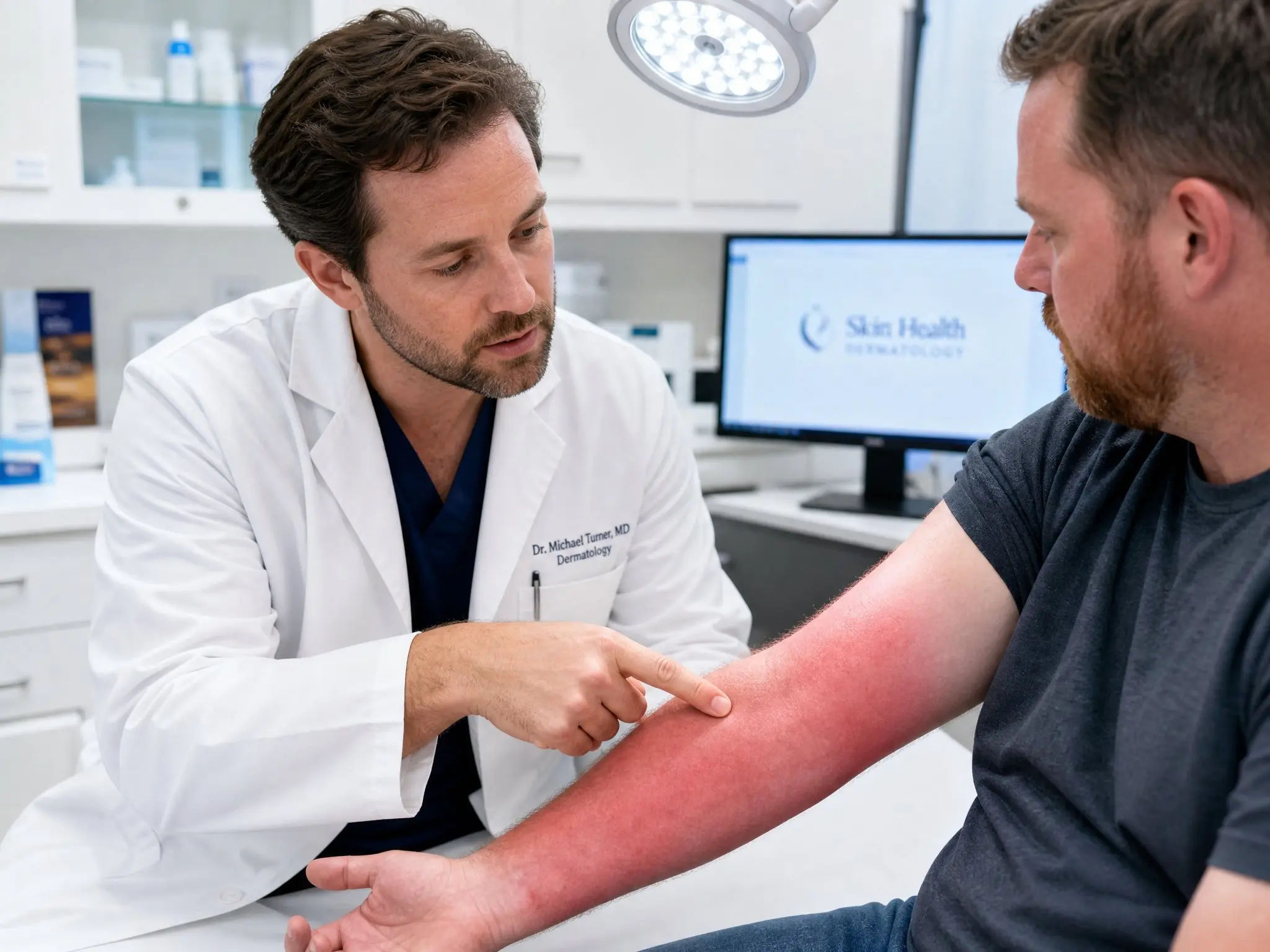
Commonly reported: injection-site reactions, headache, nausea, dizziness, fatigue, appetite shifts. With topical GHK-Cu, irritation and skin discoloration can happen, especially layered with aggressive actives.
Red flags that mean stop and get medical care — not "push through": chest pain, shortness of breath, fever, spreading redness at an injection site, hives, facial swelling, or neurological symptoms.
Who should not experiment with this
If you have a history of cancer, you should not be casually experimenting with growth- and angiogenesis-signaling compounds — both BPC-157 and TB-500 promote blood-vessel growth and cell proliferation, processes also involved in tumor growth. Same hard "no" if you're pregnant or trying, immunocompromised, on anticoagulants, managing uncontrolled autoimmune disease, or post-op with a surgeon's specific plan. You don't freelance a regenerative-medicine experiment on top of any of that.
If you compete, it's not even a debate
USADA explicitly lists BPC-157 as prohibited. TB-500 sits in the same banned regulatory neighborhood, and you can browse the real consequences in the USADA sanctions database. Both are prohibited under WADA.
Sourcing and sterility
This is where people get hurt quietly: endotoxin, mislabeling, poor sterile technique, mystery solvents. A properly overseen 503A/503B compounding pharmacy is a different universe from a random vial with a nice label — though even the legal landscape is choppy, with ongoing compounding legal battles.
A non-negotiable checklist people skip too often:
- Ask for independent third-party testing — a vendor's own COA is not the same as independent verification.
- Confirm sterile, single-use supplies and sane injection hygiene.
- If you can't confidently explain reconstitution, storage, and expiration, don't inject.
- If a source can't answer basic questions, that is your answer.
And ignore invented vendor "standards." A standard doesn't become a standard because someone typed it on a product page.
Frequently asked questions
Is the Wolverine stack FDA-approved?
No. Neither BPC-157 nor TB-500 is an FDA-approved drug for tendon or muscle healing, and neither can be legally sold as a dietary supplement in the U.S. That affects both safety and product consistency.
Does the Wolverine stack actually work?
The mechanisms are plausible and the anecdotes are loud, but rigorous human trials are lacking. Most credible reports describe reduced pain and better training tolerance rather than proven structural repair.
How fast do people feel it?
Anecdotally, some report pain shifts within days. Real tissue remodeling runs on a longer clock — fast symptom relief can be genuine without proving anything structural healed.
Is TB-500 the same as thymosin beta-4?
No. Thymosin beta-4 is the natural, endogenous peptide; TB-500 is typically sold as a fragment or derivative concept.
Can I just use GHK-Cu for skin and skip injections?
For skin goals, topical GHK-Cu is the more common lane and avoids injection risk. Patch-test it first — irritation is common when people rush.
Do oral BPC-157 capsules work?
People talk about capsules, but the strongest injury-related claims are tied to injection use. Oral absorption and bioavailability remain open questions.
The bottom line
The cleanest, least romantic read: the Wolverine stack lives in that frustrating space where mechanisms look intriguing, anecdotes are loud, human clinical data is limited, and sourcing ranges from medical-grade to science-fair chaos.
If it helps, it most likely helps as an adjunct that makes recovery a little more workable while you do the real work — rehabilitation and intelligent loading. Skip the rehab and hope a peptide will substitute for a treatment plan, and you're basically buying optimism in a vial. Before combining anything, it's worth running it through a framework for evaluating peptide stacks.
If you're still tempted: do it under medical supervision, treat sterility like religion, and keep your expectations on a leash. That's the grown-up version of the "ultimate recovery protocol."
This article is for educational purposes only and is not medical advice. Neither BPC-157 nor TB-500 is FDA-approved; both are prohibited in competitive sport. Talk to a qualified clinician before starting any peptide protocol.