


GHK-Cu vs BPC-157 vs TB-500: Use Cases & Safety Guide

GHK-Cu vs BPC-157 vs TB-500
If you've been hanging around the peptide corners of the internet long enough, you've seen the same three names get treated like a holy trinity: GHK-Cu for glow, BPC-157 for "my elbow is finally usable," TB-500 for "my whole body feels younger." And then the marketing kicks in and suddenly you're supposed to believe you can brute-force biology with a syringe.
So let's be annoyingly practical.
GHK-Cu is usually the best fit for skin and aesthetics (collagen, texture, hair-adjacent goals). BPC-157 is the best fit for localized soft-tissue and gut-focused recovery. TB-500 is the best fit when you want broader, system-wide support for mobility and chronic "everything feels tight" problems. Stacking can make sense, but only if your rehab and load management are already dialed in, because the "Wolverine protocol" hype is often a confidence story layered over inconsistent real-world outcomes.
And yes, sourcing and compliance are the unsexy part that decides whether any of this is helpful, useless, or a regrettable experiment.
Comparison Table
|
Criteria |
GHK-Cu |
BPC-157 |
TB-500 |
|---|---|---|---|
|
Primary "lane" in real-world use |
Skin benefits, tissue remodeling, cosmetic-adjacent recovery |
Localized soft tissue and gut support |
Systemic repair feel, mobility, chronic injury support |
|
Mechanism shorthand |
Copper-binding signal peptide that nudges collagen synthesis and wound applications |
Tissue protection, angiogenesis signaling, nitric oxide balance effects discussed in preclinical work |
Thymosin beta 4 fragment marketed as TB-500, associated with actin and cell migration pathways |
|
Where people "notice it" first |
Skin texture, redness, post-procedure recovery vibe |
One stubborn tendon or joint that finally calms down |
General movement quality, stiffness, "I can train again" tolerance |
|
Typical use case |
Aesthetics, scar support, skin regeneration goals |
Tendon and ligament issues, gut irritation patterns |
Chronic multi-area niggles, broad musculoskeletal repair support |
|
Administration reality |
Often topical or subcutaneous, can sting for some |
Often subcutaneous, sometimes "near injury site" by user preference |
Subcutaneous, usually treated as systemic |
|
Evidence vibe |
More published discussion, still not a clean consumer product story |
Lots of animal data, thin human clinical clarity for many claims |
Even more theory-heavy for typical gym use, fewer grounded outcomes |
|
Best fit if your main goal is... |
Looking better, skin healing, collagen production |
One clear injury or gut issue you can track |
Overall movement and chronic recovery support |
If you want the fastest "which one do I pick" logic without the fairy dust, I'd narrow it like this:
-
Skin/aesthetics first: GHK-Cu.
-
One angry tendon or nagging soft tissue issue: BPC-157.
-
You feel beat up everywhere and you want systemic support: TB-500.
-
Stacking: only when you can explain what each compound is supposed to do for your specific goal, in a sentence, without sounding like you're auditioning for a biohacker podcast.
GHK-Cu

Core mechanism
GHK-Cu (often written as ghk cu, copper peptide, or cu peptide) is a naturally occurring copper-binding tripeptide found in plasma, and it shows up in the literature as a signaling compound involved in wound applications, inflammation modulation, and tissue remodeling. The part people actually care about is fibroblast behavior and collagen synthesis, because that's the language of skin quality, scar appearance, and the slow unglamorous business of rebuilding structure.
If you want a deeper mechanistic read that doesn't sound like a product page, the 2018 review on PubMed Central about the peptide's regenerative actions is a solid starting point: regenerative and protective actions of GHK-Cu.
Best-fit goals
GHK is the one I associate with "I want to look healthier" more than "I want to deadlift next week." It's the skin health pick, the post-procedure support pick, the "my face looks tired and my scars bother me" pick. People also talk about hair, but hair outcomes are messy and slow, and anyone promising certainty is selling you something.
If you're shopping, this is the specific product page most people mean when they say it in this context: GHK-Cu 50 mg.
Realistic outcomes
Realistic means you're playing a longer game. You might see cosmetic shifts in a few weeks, but structural change is gradual, and it's sensitive to everything else you do: sun exposure, protein intake, sleep, topical irritation, even whether you're constantly inflaming your skin with harsh actives because you saw a reel about "glass skin."
Also, GHK-Cu gets stuffed into stacks as a kind of "structural integrity polish," and I'm more skeptical there. My experience watching how people talk about it is that it's easy to narrate, harder to confirm. A cleaner way to think about it is: if your goal is skin regeneration or skin healing, it fits. If your goal is surgical healing in the orthopedic sense, it's not the first lever I'd pull.
BPC-157

Core mechanism
BPC-157 (bpc 157, sometimes shortened to bpc) is a synthetic fragment originally derived from a gastric protein context, which is why gut support and tissue protection are so central to how it's discussed. Mechanistically, you'll hear a lot about angiogenesis, endothelial support, inflammatory cytokines shifting, and nitric oxide balance. That's the preclinical story, and it's not nothing, but it's also not a guarantee of predictable human outcomes across every injury.
What matters in daily use is that BPC-157 is treated as the "localized repair" tool. People like it when they can point to one problem and track it: a tendon flare, a cranky shoulder, a post-training ache that keeps returning at the same spot.
The specific product page in your outline is here: BPC-157.
Best-fit injuries
If someone tells me they have one stubborn tendon issue, I understand why they'd look at BPC-157 first. Tendons and connective tissues are slow to adapt, low blood flow, dramatic mood swings based on load, and rehab can feel like psychological warfare. BPC-157 is popular because it's often described as making rehab tolerable, which means people do the boring work more consistently.
Oddly enough, the best "use case" is not always the most dramatic injury. It's the annoying one that keeps interrupting training. The golfer's elbow vibe. The Achilles that's not torn, just angry. The shoulder that feels like it has a grudge.
Realistic outcomes
My contrarian take, based on watching stacks rise and fall in gym communities: a lot of "bpc 157 work" stories sound like two different things mashed together.
One, pain and inflammation drop, so movement improves. Two, the person stays consistent with rehab because it finally feels doable. Add placebo and expectation, which are real, and you get an outcome that feels like regeneration even when it's mostly better adherence.
The mess nobody wants to highlight is variability. A lot of "it worked" versus "it did nothing" can be purity, storage, dosing accuracy, timing, and whether the person stopped provoking the injury. I'm not saying it's fake. I'm saying it's an experiment with foggy controls. That's also why I like how this comparison breakdown talks about the sourcing and consistency problem without pretending it's all clean and clinical.
TB-500

Core mechanism
TB-500 is commonly sold as a thymosin beta 4 related fragment (thymosin beta 4, thymosin), and the "why" people repeat is actin upregulation and cell migration. In normal-person terms, it's framed as a systemic support signal, less "fix this exact spot," more "help the body move repair cells around and calm down globally."
That's why TB-500 is often described as a recovery lubricant. The name is goofy, the concept is intuitive: if you feel beat up in multiple places, a systemic approach seems appealing.
Here's the specific product page from your outline: TB-500.
Best-fit injuries
TB 500 tends to be chosen when injuries are chronic, multi-site, or fuzzy. The stuff that doesn't scan well on an MRI but keeps you from rotating your spine, fully flexing a knee, or training without feeling like you're ninety. It also gets picked when someone is tired of daily anything and prefers protocols that feel less intrusive.
If your issue is truly localized and mechanical, TB-500 can feel like you brought a leaf blower to blow one speck of dust off a table. It might work, it might not, it might just make the room louder.
Realistic outcomes
Realistic is: you might notice improved movement tolerance, reduced background soreness, maybe better flexibility if your tightness is inflammation-linked rather than purely structural. The downside is that TB-500 outcomes are often the easiest to over-interpret because they're systemic and subjective. When someone tells me it "fixed everything," I assume they also changed training load, sleep, or did actual stretch therapy, even if they don't mention it.
Also, TB-500 is the one where the gap between "mechanism talk" and "human data for this exact use case" tends to be widest. Keep your expectations tight. No pun intended.
Pros & Cons
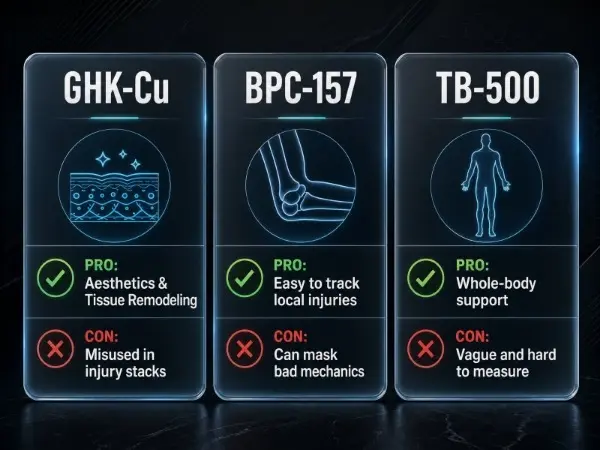
People love to argue these like they're Pokémon evolutions. It's more mundane than that.
BPC-157's big pro is that it's easy to match to a specific problem and run a tight self-experiment. The con is that localized focus can make people ignore the actual cause, poor mechanics, dumb programming, bad sports injury care habits.
TB-500's pro is whole-body support and convenience. The con is vagueness. If you don't have a clear baseline, you'll end up "feeling something" and calling it comprehensive healing, which is how supplement culture keeps the lights on.
GHK-Cu's pro is that it actually belongs in the aesthetics and tissue remodeling conversation. The con is that it gets dragged into injury stacks as a symbolic gesture, like adding fancy sea salt to a meal you forgot to cook.
Safety-wise, all three share the same uncomfortable umbrella: limited high-quality human trials for the sweeping claims people make online, quality variation in gray markets, and the reality that injecting anything has risk. If you're under a medical wellness center or physician-led treatment plan, great, that's the adult version of this. If you're freestyling based on a subreddit protocol, at least admit the uncertainty.
If you want a blunt take on post-surgery stacking culture, this post-surgery peptide stack perspective captures the vibe that "more compounds" often becomes a story people tell themselves.
Choose by goal and stack logic

Stacking can be logical, but only if you respect roles.
The cleanest stack logic I see in the wild is what people call bpc 157 synergy with a tb 500 stack: BPC-157 as the local environment builder, TB-500 as the systemic support signal. Then GHK gets added when the goal includes collagen production and skin regeneration, or when someone wants the "quad healing blend" vibe that sounds comprehensive.
Here's where I get cranky. When stacks get big, people stop tracking anything. No baseline pain score, no range-of-motion check, no consistent rehab plan, no load management. Then any good week becomes "synergistic healing," any bad week becomes "I need a higher dose," and suddenly we're doing narrative therapy instead of actual therapy.
If you're choosing by goal, I'd think like this:
If your primary outcome is skin benefits and cosmetic tissue quality, you pick GHK-Cu and you judge it like a skincare intervention, photos, texture, irritation, timeline.
If your primary outcome is a single tendon or connective tissue issue, you pick BPC-157 and you judge it like a rehab support tool, pain with movement, tolerance to eccentric loading, flare frequency.
If your primary outcome is overall wellness and comprehensive recovery feel, TB-500 fits, but only if you're honest about what you're measuring, because "I feel better" is real but slippery.
Compliance note, because it matters: in the United States, none of these are FDA-approved dietary supplements, and the regulatory status for typical consumer purchase is a gray mess. If someone tells you "FDA approved," push back. If you're under medical supervision and using properly sourced compounded products where legally appropriate, that's a different conversation. Most people are not.
Final Verdict
If you're choosing one, choose the one that matches what you can actually measure.
Choose GHK-Cu if you're aesthetics-driven, skin-first, and you want tissue remodeling support you can see over time. Avoid it if you're trying to brute-force an orthopedic comeback and you're secretly hoping for a miracle.
Choose BPC-157 if you have a localized injury pattern, especially tendons and connective tissues, or gut irritation that you can track. Avoid it if you won't fix training errors, because it's not a substitute for load management.
Choose TB-500 if your issues feel systemic, chronic, and multi-area, and you want a broader recovery assist. Avoid it if you need a precise tool for a precise problem, because TB-500 is often too diffuse to keep you honest.
Stacking makes sense for disciplined people with clear goals, and it's mostly a waste for people who want "more chemicals = more destiny." If you're the second person, you're not doomed, you're just shopping for a story.
FAQ
Can I take all three together (a peptide stack)?
You can, but you should not assume "more" equals comprehensive healing. Stacking increases cost and variables, and it makes side effects and sourcing issues harder to interpret. If you cannot explain what each one is doing for your goal, keep it simple.
Which is best for tendon repair?
BPC-157 is the usual first choice for tendon complaints in real-world use because it's treated as localized support. TB-500 is more often added when problems feel widespread or chronic.
Which is best for skin regeneration and anti-aging?
GHK-Cu, almost every time. It's the one with the strongest identity around collagen synthesis, skin healing, and cosmetic outcomes.
Do these peptides increase growth hormone?
People sometimes mix up peptide therapies with growth hormone secretagogues. GHK-Cu, BPC-157, and TB-500 are not the classic GH-releasing peptides. If someone is selling them to you as direct growth hormone boosters, be skeptical.
What are common side effects people report?
Injection-site irritation is a big one, and then the usual nonspecific stuff like headaches or feeling "off." The bigger risk category is quality variation and sterility. That part is boring, and it's also the part that can actually hurt you.
Are they FDA approved?
Not as dietary supplements, and not as broadly approved consumer drugs for the claims you see online. If you're considering use, medical supervision and legitimate sourcing are the adult safeguards, especially if you're dealing with surgical healing or chronic inflammation patterns.
Articles
So you have decided to embark upon your very first adventure known as a prohormone cycle! Without a doubt, you are going to enjoy the results that you are about to see.

An oral steroid stack means running two or more oral anabolic-androgenic steroids in the same cycle. It does produce a more aggressive anabolic environment - and it also roughly doubles the hepatic load, because nearly every oral AAS is C-17 alpha-alkylated specifically to survive the liver.
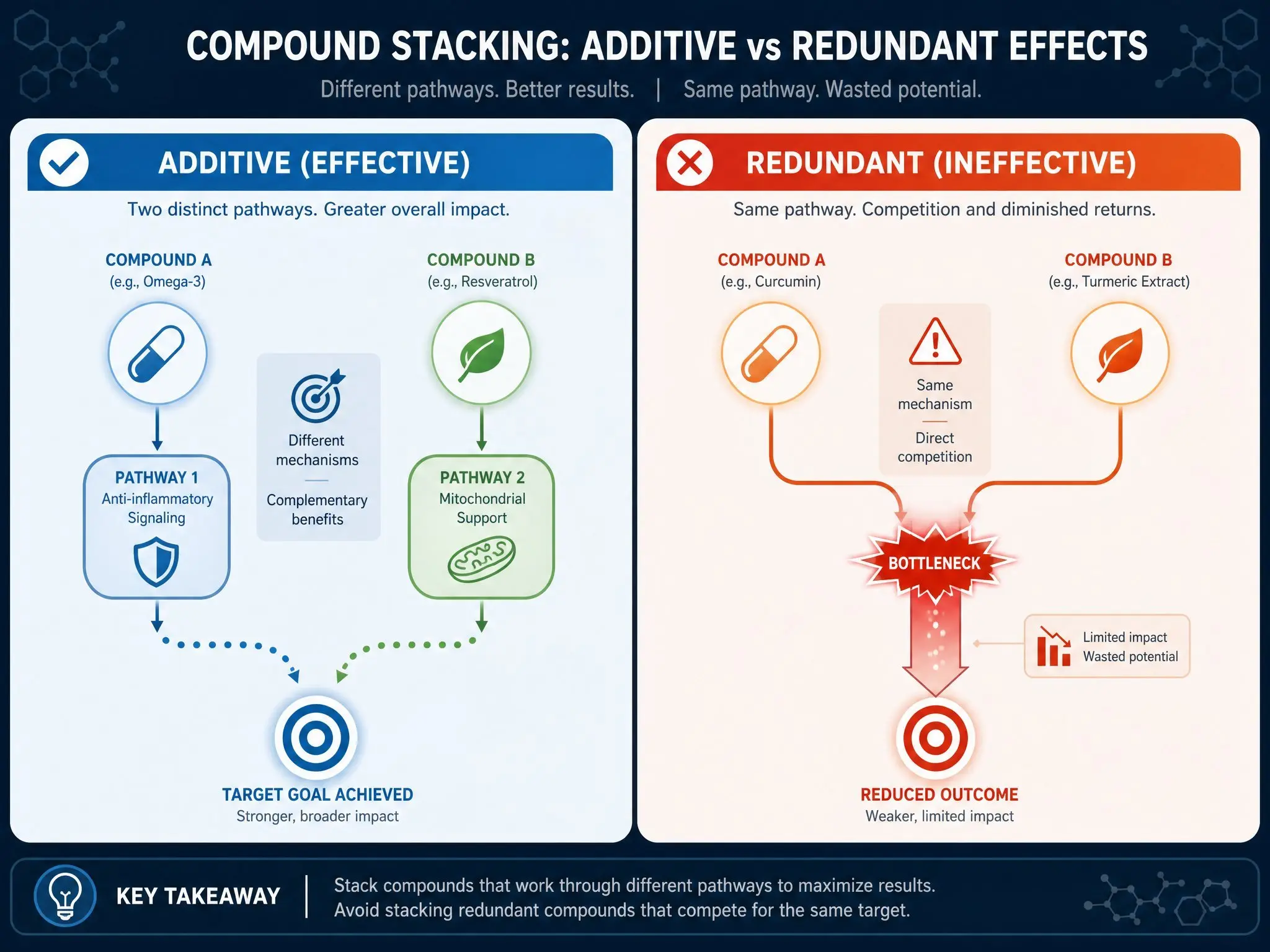
Combining peptides is rational only when each one has (1) a clear job tied to a single outcome, (2) non-overlapping mechanisms you can explain without hand-waving, and (3) monitoring and stop criteria you'd actually follow when things get weird.
Customers Reviews
Please leave your review on products or service below.
Thank you beforehand.
- Excellent site and very easy to navigate.
- Easy to use and locate items.