
Deload Week: Signs You Need One and How to Recover
Quick answer: You need a deload when normal loads feel heavy across multiple sessions, you're sleeping but not waking restored, mood and motivation slide together, and session quality drops while effort stays maximal. Recovery after a heavy block isn't complicated — cut the load, sleep more than feels reasonable, replace fluids and sodium, eat enough protein and carbs, keep light movement in the week — it's just annoyingly disciplined. The adaptation you trained for gets cashed in during recovery, not during the hard session.
Most people finish a heavy block and make the same mistake on instinct: they feel flat, heavy, weirdly uncooperative — and try to train through it. That usually backfires, because heavy blocks are supposed to create stress. The problem starts when you keep layering intensity on top of incomplete recovery and call it toughness.
Overreaching vs overtraining: know which one you're in
This distinction does more work than any recovery gadget you can buy. The joint ECSS and ACSM framework for non-functional overreaching draws a line athletes and coaches should respect: a short dip in performance after a demanding block can be normal and productive. A prolonged slide — with mood changes, poor sleep, and stale legs that don't bounce back — is a different animal entirely.
A clinical review of overtraining syndrome makes the stakes clear: under-recovery isn't just tired legs. It can drag in the endocrine system, the immune system, mood, sleep, and performance all at once. A few clues usually show up first — resting heart rate creeping up, normal paces feeling oddly expensive, motivation dropping in a flat and wired way rather than a lazy one, soreness lingering longer than usual, and sleep getting worse precisely when you need it most.
Signs you need a deload
When should you stop guessing and schedule one? Usually earlier than your ego wants.
A simple tool like session RPE load calculation catches this before it becomes a mess. If every session has felt like an 8 or 9 out of 10 for days on end, you're not being tough — you're accumulating a debt.
Worth knowing: individual variation here is large. Research on nocturnal heart rate and HRV recovery responses shows some athletes bounce back from intensified blocks quickly while others stay suppressed far longer. Same training on paper, very different recovery in real life. Your training partner's schedule isn't evidence about you.
What's actually happening after a hard block
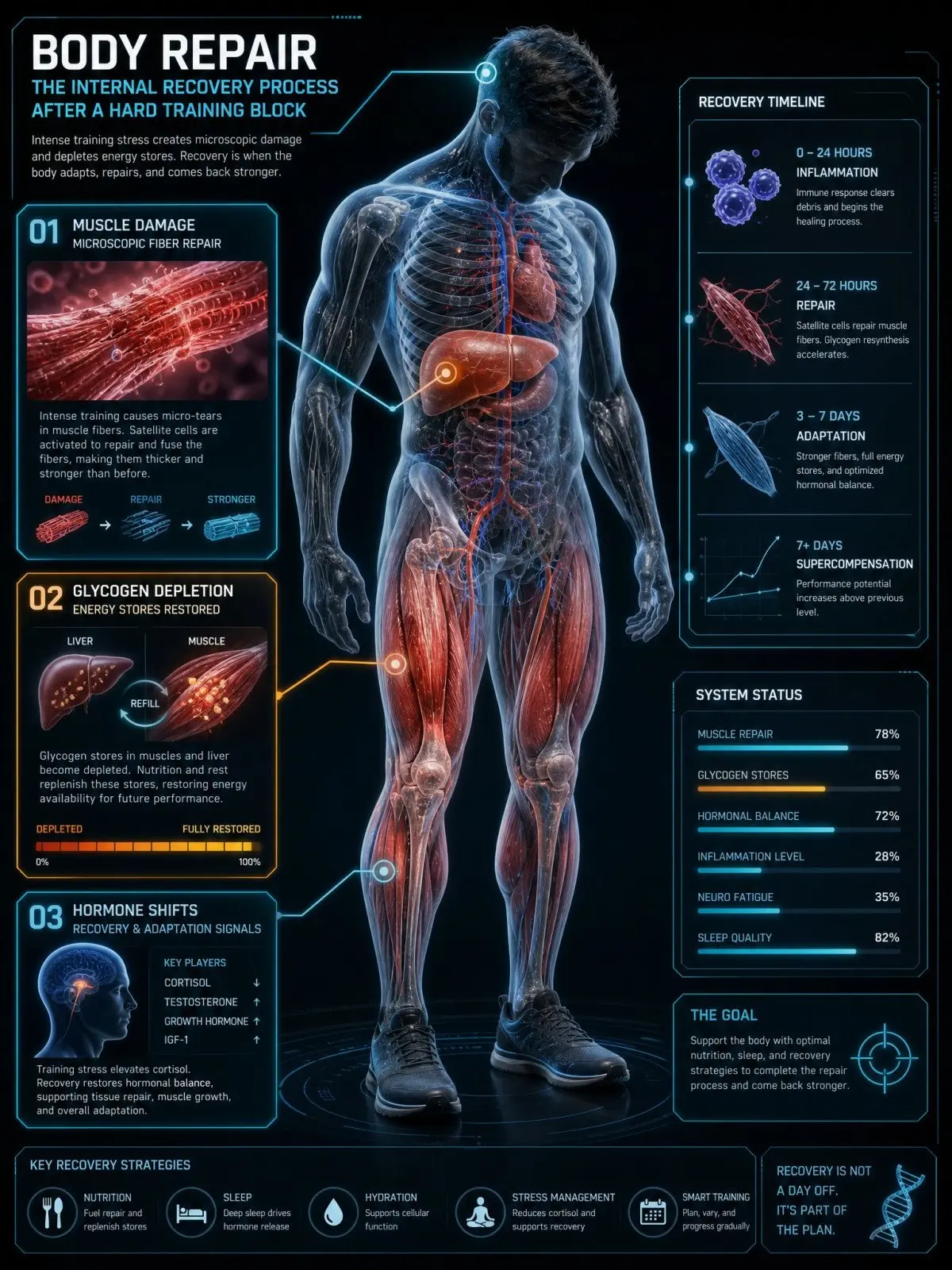
Even when you're sitting still, there's a pile of repair work underway.
Muscle damage and remodeling is the obvious one — micro-damage from eccentric loading gets repaired, and that process takes calories and time. Glycogen depletion is the quieter one; muscle fuel stores need replacing, and until they are, everything feels heavier than it should. Hormone shifts round it out: cortisol rises, testosterone can dip, thyroid output and appetite signals wobble, and autonomic balance tilts. Sleep gets lighter. Mood gets touchy.
That's the whole case for structured recovery. The body doesn't get stronger during the hard session — it gets stronger afterwards, assuming you actually give it an afterwards.
Build recovery around the 4 Rs
People love recovery products because they feel active — buy the gadget, drink the powder, sit in the tub, post the photo. Some of that helps. The foundation is still rehydrate, refuel, repair, rest.
Rehydrate
Sweat loss stacks up across a heavy cycle. When body water drops, blood volume drops with it, heart rate runs higher, and recovery slows. A practical rule: for every pound lost during exercise, drink roughly 20–24 fluid ounces over the following hours. Plain water isn't always enough — if the session was long, humid, or salty, you need sodium too. A recovery drink works; so does water plus a salted meal.
Refuel
The post-exercise window is real, though people make it mystical. For most athletes, 20–40 g of quality protein with carbohydrate in the first 30–120 minutes is a solid target, especially with another session coming soon.
| Need | Practical target | When it matters most |
|---|---|---|
| Protein | 20–40 g after exercise; roughly 0.11–0.18 g per lb bodyweight per meal across the day | After strength training; larger athletes |
| Carbohydrate | ~0.45–0.55 g per lb per hour for the first few hours | Fast turnaround; endurance and interval work |
| Fluids | 20–24 fl oz per pound lost | Always; more urgent in heat |
| Sodium | Salted meals, broth, or an electrolyte mix | After heavy or salty sweat loss |
If your next hard effort is tomorrow evening rather than in four hours, the urgency drops — but under-eating still slows recovery either way.
Sleep is the centre, not the accessory
During deep sleep, growth hormone pulses, muscle repair accelerates, cortisol settles, and the brain finally stops behaving as though the session is still happening. A well-known set of Stanford sleep-extension data showed better speed, accuracy, and mood in athletes who meaningfully increased sleep time. No magic — just biology getting enough room to work.
Seven to nine hours is a reasonable baseline. After a hard block or during a recovery week, many athletes do better closer to 8.5–10 hours if life allows. Not every night cooperates, and that's fine. The point is to stop treating sleep as spare time. If your recovery week includes late caffeine, screens in bed, early alarms, and social events, the reason your sessions feel worse may be less mysterious than you'd like.
Rest days and light movement
A rest day should match the damage. After one very hard session, a fully passive day can be right. After a string of them, one or two low-output days usually beat white-knuckling another interval session.
That doesn't mean becoming a statue — complete stillness is overrated. Walking, easy cycling, casual mobility work, gentle yoga, or a short recovery ride all help by promoting blood flow without adding meaningful stress. The rule is simple: active recovery should feel obviously easy. If you're using cardio to punish yourself for lifting less, you haven't deloaded at all — you've just changed the shape of the stress.
How long should recovery take?
After a single hard session, most people feel functional again in 24–72 hours. After a demanding block, a genuine recovery week is more realistic — and if performance hasn't rebounded after two weeks of real deloading, that's the signal to stop self-managing and get assessed properly.
Ease back gradually rather than resuming exactly where you left off. Jumping straight back to pre-deload loads is a reliable way to undo the recovery you just bought.
Mistakes that slow progress most
- Treating soreness as the only signal. You can be under-recovered without being sore, and sore without being under-recovered.
- Replacing lifting volume with hard conditioning. That's not a deload; it's a substitution.
- Under-eating during the recovery week because you "didn't earn it." Repair costs calories.
- Chasing recovery gadgets while sleeping six hours. The expensive tool can't outrun the free one you're skipping.
- Waiting for permission. By the time a deload feels obviously justified, it's usually late.
Frequently asked questions
What are the signs you need a deload?
Normal loads feeling heavy across multiple sessions, sleeping without waking restored, motivation and mood sliding together, and session quality dropping while effort stays maximal. If two or more show up together, schedule it.
What's the difference between overreaching and overtraining?
Functional overreaching is a short performance dip after a hard block that rebounds within days to about two weeks — it's productive by design. Non-functional overreaching and overtraining involve a prolonged slide with mood changes, sleep disruption, and legs that don't bounce back. The test is whether performance returns when load drops.
How long should a deload week be?
Usually about a week of genuinely reduced load. If performance hasn't recovered after two weeks of real deloading, that points toward something beyond ordinary training fatigue and deserves proper assessment.
Should I rest completely or do active recovery?
For ordinary accumulated fatigue, light movement generally beats total stillness — walking, easy cycling, mobility work. Complete rest makes more sense after illness, injury, or genuine burnout. The key is that active recovery must actually feel easy.
How much protein do I need after training?
Around 20–40 g of complete protein after a hard session, with larger athletes often doing well at roughly 0.11–0.18 g per pound of bodyweight per meal across the day.
Can I lose fitness during a deload?
Not meaningfully over a week of reduced load. Measurable strength loss takes considerably longer than most people fear, and the fitness that was masked by fatigue typically shows up once the fatigue clears.
The bottom line
Recovery after a heavy block is simple on paper and disciplined in practice: cut the load, sleep more than feels reasonable, replace fluids and sodium, eat enough protein and carbohydrate, and keep some easy movement in the week.
The part worth internalising is the distinction between a productive dip and a slide that won't rebound. Watch for the deload signals early, act on them before your ego signs off, and remember that the block only pays out if you let the recovery happen.
This article is for general educational purposes and is not individual medical or coaching advice. Nutrition and sleep targets are general guidance for healthy adults training hard; individual needs vary considerably. If fatigue, mood changes, or performance decline persist despite genuine rest, or if you have any underlying health condition, speak with a qualified clinician rather than self-managing.