


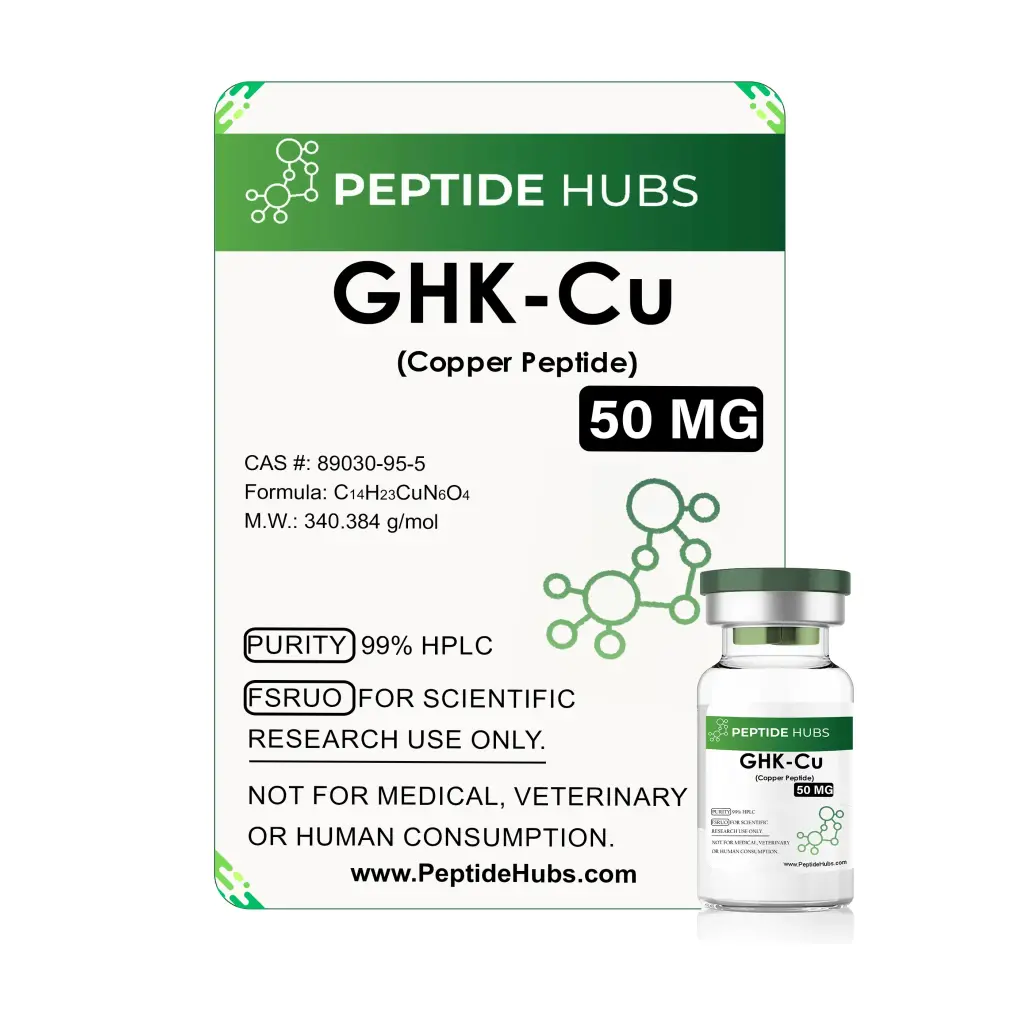
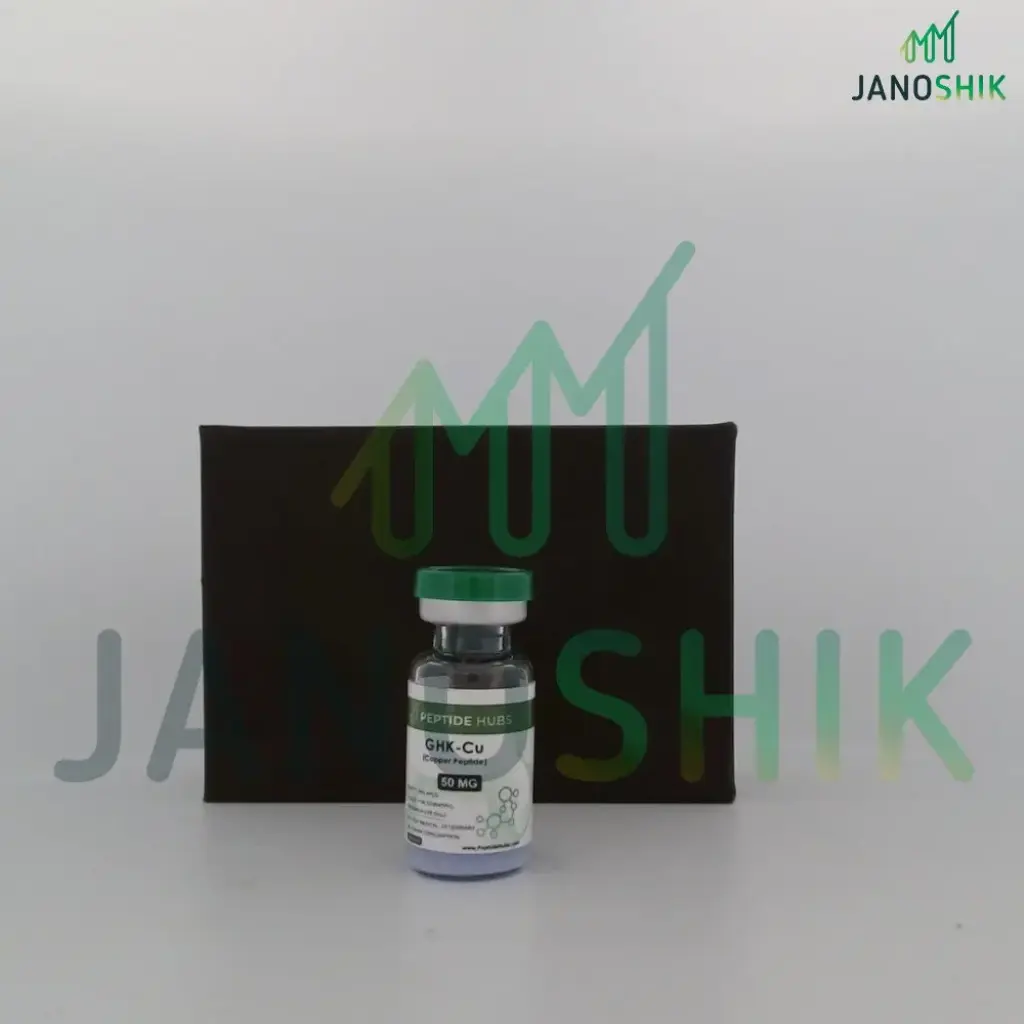
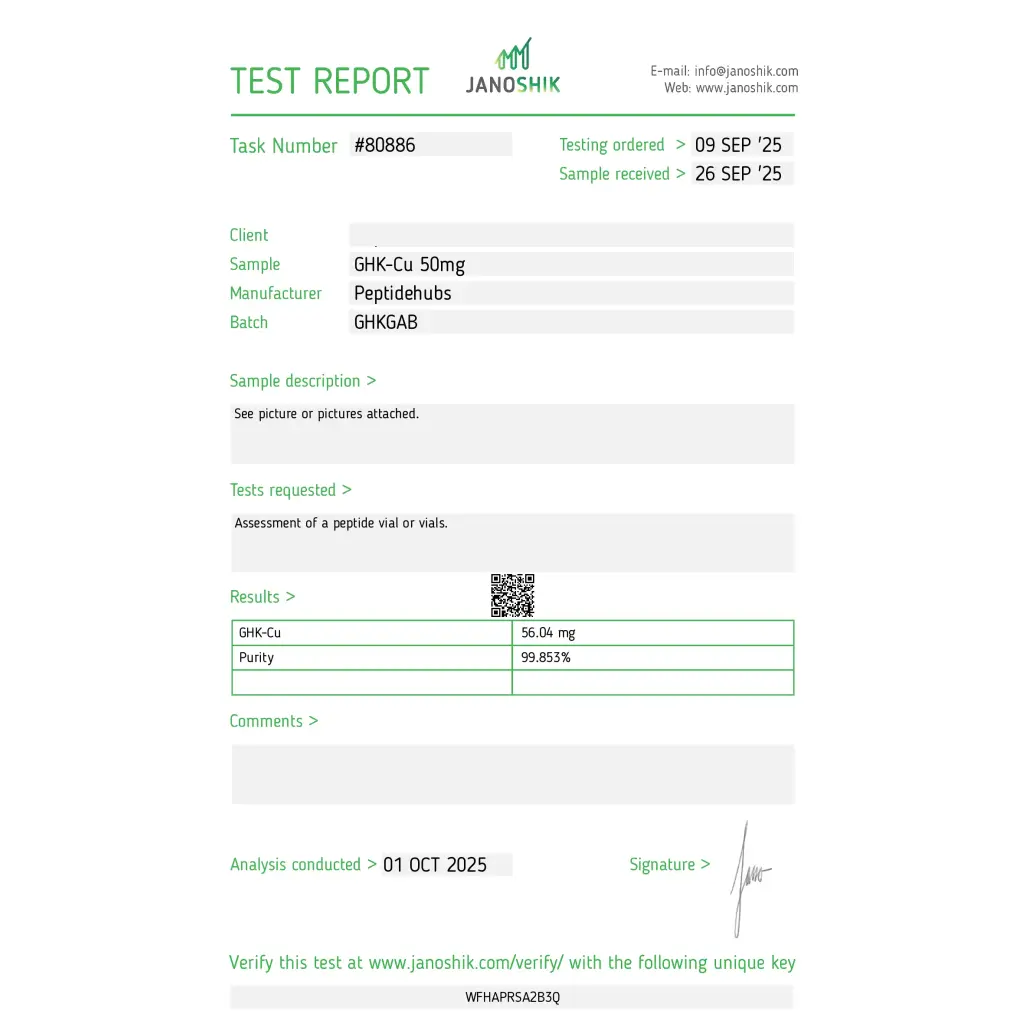
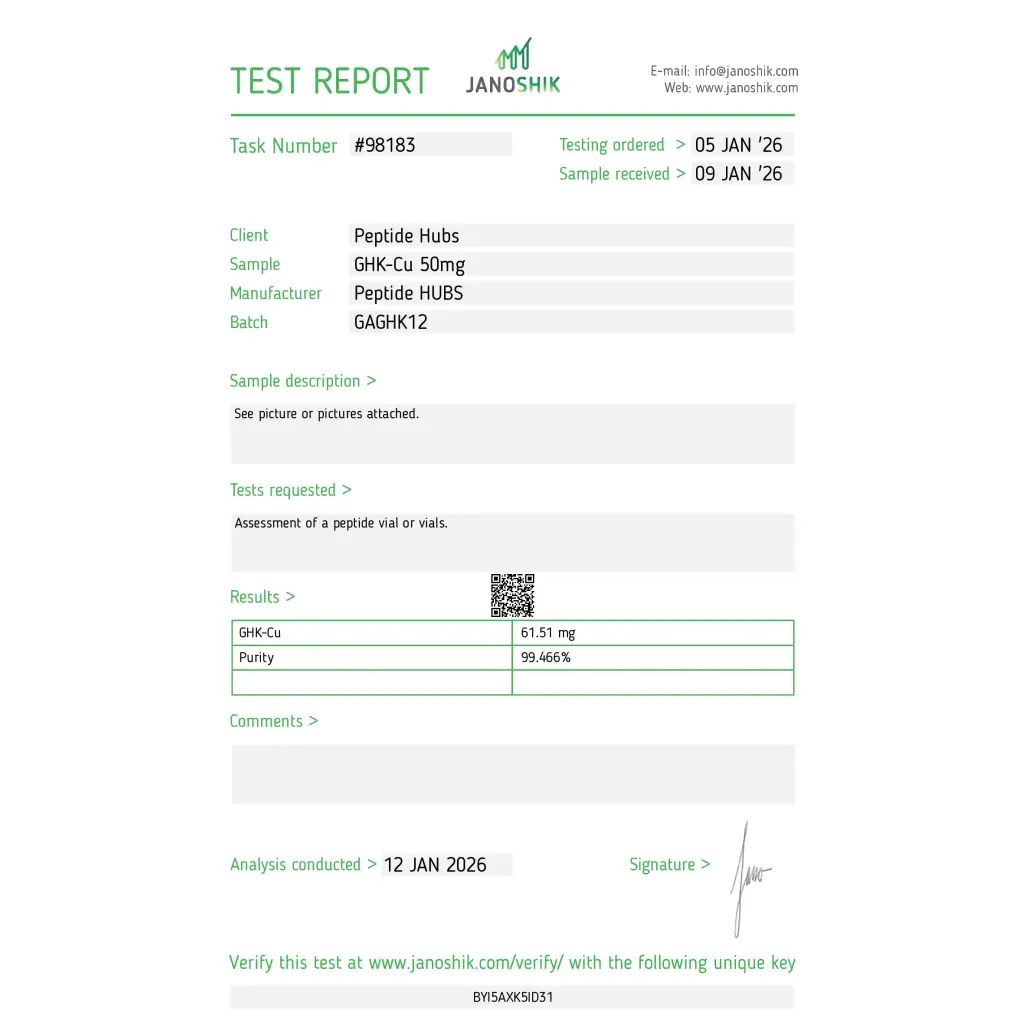
Manufacturer: Peptide Hubs
Pharmaceutical name: GHK Copper
Pack: vial (10mg)
⚠️ Provided in a lyophilized powder for stability
GHK-Cu 50mg (Copper Tripeptide-1) by Peptide Hubs is a high-quality peptide known for its remarkable ability to speed up tissue repair, boost recovery, improve skin quality, and support athletic performance. If you're lifting hard, bleeding from small tears, dealing with joints, or trying to keep skin tight while cutting, GHK-Cu helps you bounce back faster and look better doing it.
What makes GHK-Cu special is its dual role: it acts as a signal for collagen production, which helps support tendon, skin, and connective tissue integrity, and it also has antioxidant and anti-inflammatory effects, reducing oxidative damage from intense sessions. Athletes who use it report less irritation, quicker reduction of inflammation, and better visual appearance of muscles and skin during lean phases.
GHK-Cu binds to copper and acts as a signaling molecule. It promotes collagen and elastin production, encourages antioxidant defenses, and helps cells regenerate. In athletic stress, this supports recovery of skin, tendons, ligaments, and improves the health of your connective tissues. It doesn't build muscle directly, but by helping your body repair better, your performance climbs and your physique looks cleaner.
Many lifters include GHK-Cu during lean cuts or recomposition phases when skin elasticity and slow healing become noticeable issues. Use 1 mg-2 mg injected or applied (depending on formulation) several times per week; protocols vary. Combine with high protein, good vitamin C intake (for collagen), and ensure you're getting copper and trace mineral support in your diet. Don't ignore skin care: staying hydrated and protecting skin from sun helps maximize effects.
| Feature | GHK-Cu | AOD-9604 | NAD+ |
|---|---|---|---|
| Primary Role | Skin/tissue repair & recovery | Fat loss / lipolysis | Cellular energy & endurance |
| Best For | Athletes worried about skin & joint integrity | Cutting / stage prep | Energy blocks / recovery days |
| Visible Effects | Skin texture, scar reduction | Fat loss visible | Energy & fullness |
| Stack Utility | Great with peptides & repair stacks | Most with fat loss stacks | Energy & mitochondrial support |
It's used to promote skin and soft-tissue recovery, reduce inflammation, improve the look of skin and scars.
Yes - it supports connective tissue repair, which helps reduce soreness and improve mobility in joints and tendons.
Skin texture and reduced redness may show within a couple weeks; scar fading and tighter skin can take several weeks of consistent use.
Absolutely - these synergies help recovery, energy, and look; GHK-Cu enhances tissue repair while NAD+/other peptides boost metabolic support.
When used as directed and supported by balanced minerals, the risk is low. Monitor supplementation and food intake if copper status is high.
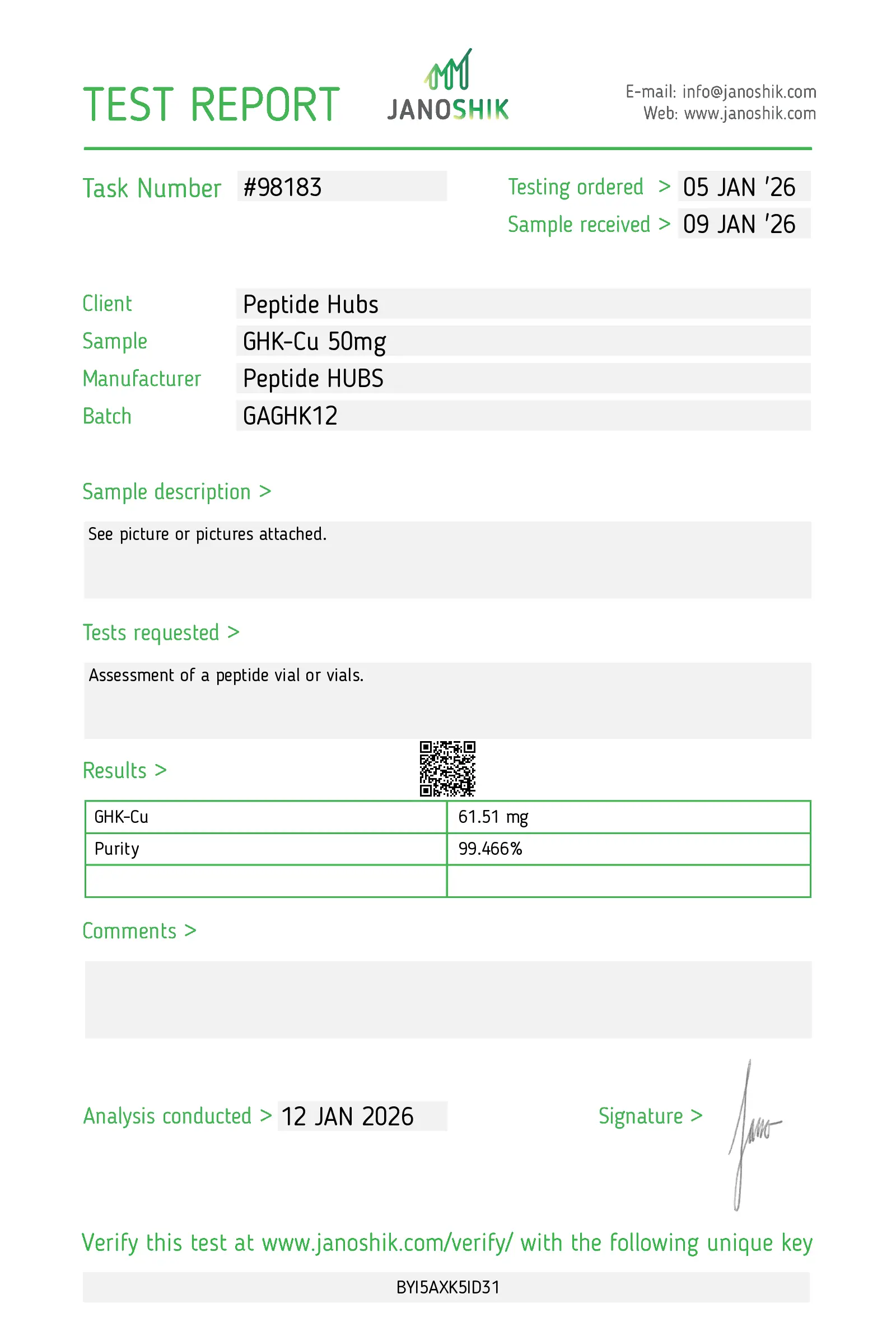
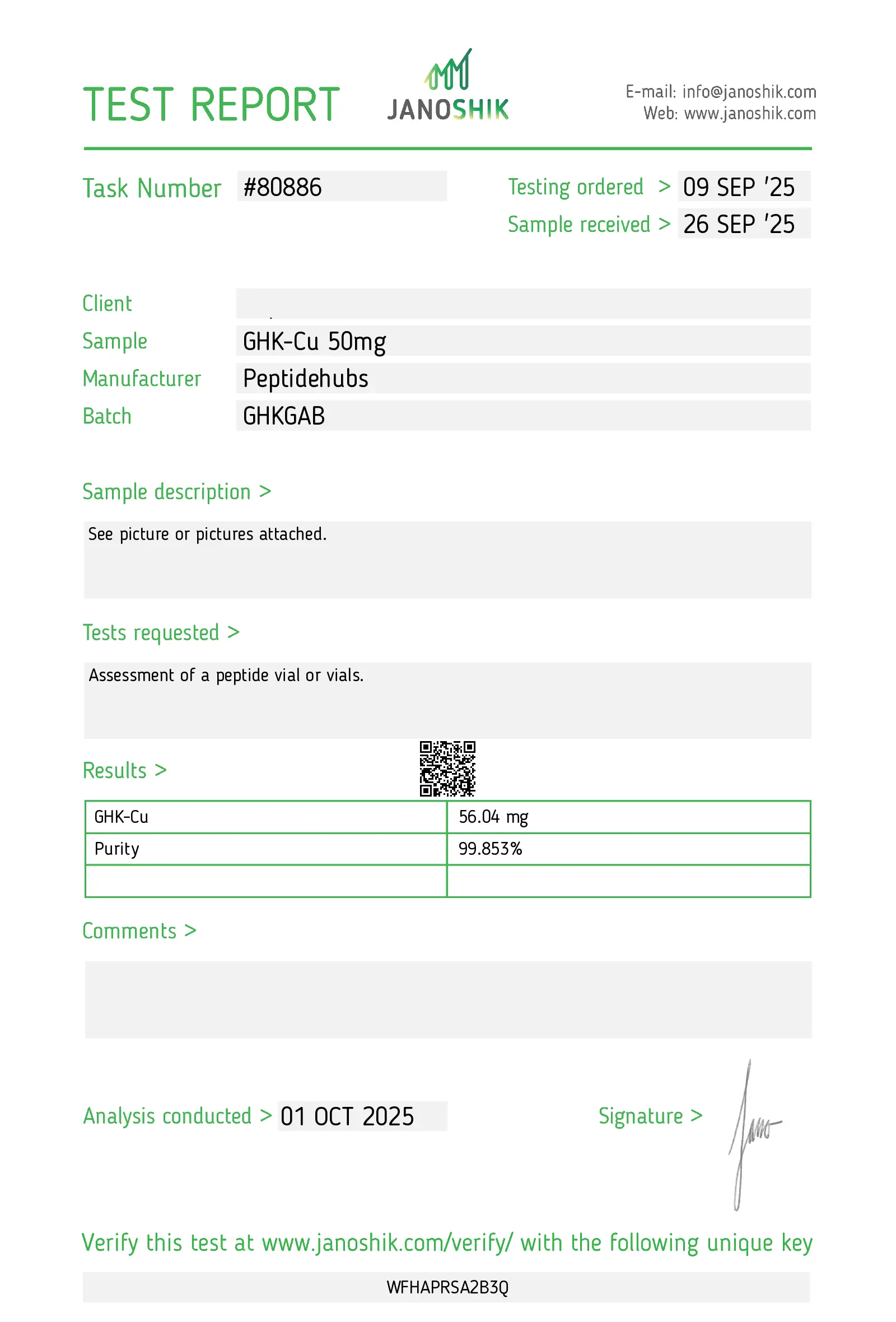
| Approach | Amount | How often | Cycle | Best suited for |
|---|---|---|---|---|
| Research and clinician-guided ranges | ||||
| Cautious start | 0.5–1 mg | Once a day | Set on/off periods | First-time users, introduced slowly |
| Standard step-up | 1 mg → 2 mg | Once a day | 30 days on, 30 days off | Skin quality and healthy aging |
| Steady daily | 1–2 mg | Once a day | Set on/off periods | Returning users who want a consistent dose |
| Higher intensity | 2–3 mg | Once a day | Short, set cycle | Tissue and connective-tissue repair |
| Standard 30-day step-up schedule | ||||
| Days | Daily dose | Stage | ||
| 1–15 | 1 mg once a day | Active, lower dose | ||
| 16–30 | 2 mg once a day | Active, increased dose | ||
| 31–60 | Rest period | Break to reassess | ||
| Key facts | ||||
| What it is | A copper-binding tripeptide (glycyl-L-histidyl-L-lysine) linked to skin renewal, collagen support, and tissue remodeling | |||
| Usual route | Injection under the skin (subcutaneous), once a day | |||
| Typical cycle | 30 days on, 30 days off, so the provider can reassess before continuing | |||
| Dosing approach | It works as a signaling peptide because of its copper component, so a higher dose is not automatically better | |||
| Often paired with | BPC-157 and TB-500 in tissue-repair discussions | |||
| Possible side effects | Reactions at the injection spot, sensitivity to copper, tiredness | |||
| Do not use if | Pregnant, breastfeeding, with Wilson's disease or another copper storage disorder, or without clinician supervision | |||
| Disclaimer | Figures are math conversions only; they do not confirm product quality, safety, or medical suitability | |||
| Reconstitution calculator | |
|---|---|
| Find out how much bacteriostatic water to add and how many units to draw on your syringe for your GHK-Cu dose. | |
| Peptide in the vial |
mg
|
| Bacteriostatic water |
mL
|
| Dose you want |
mg
|
| Syringe |
|
| Results | |
| Choose your values and press Calculate. | |
| Concentration | — |
| Amount to draw | — |
| Units to draw | — |
| Doses in the vial | — |
| How the math works | |
| 1. Find the concentration | Divide the peptide in the vial by the water added. For example, 50 mg ÷ 2 mL = 25 mg/mL |
| 2. Work out the volume | Divide the dose by the concentration. For example, 1 mg ÷ 25 mg/mL = 0.04 mL |
| 3. Convert to units | On a U-100 syringe, multiply the mL by 100. For example, 0.04 mL = 4 units |
| 4. Check the syringe | Make sure the amount fits the syringe you are using |
| Worked example | |
| Vial | 50 mg GHK-Cu |
| Water | 2 mL bacteriostatic water |
| Dose | 1 mg |
| Syringe | 100 units (1 mL) |
| Concentration | 50 mg ÷ 2 mL = 25 mg/mL |
| Amount to draw | 1 mg ÷ 25 mg/mL = 0.04 mL, which is 4 units on a U-100 syringe |
| Doses in the vial | 50 mg ÷ 1 mg = 50 doses |
| Step-up schedule example | |
| Vial | 50 mg GHK-Cu mixed with 2 mL water = 25 mg/mL |
| Days 1–15 | 1 mg a day = 0.04 mL = 4 units (15 doses) |
| Days 16–30 | 2 mg a day = 0.08 mL = 8 units (15 more doses, 30 in total) |
| Total used | 45 mg of the 50 mg vial (15 × 1 mg + 15 × 2 mg) |
| Disclaimer | |
| This tool does math conversions only. It does not choose a dose for you or confirm product quality, safety, or medical suitability. | |
Mixing a peptide takes about a minute. Keeping it good afterwards is the part most people get wrong, so follow the guide below and then store the vial the way we describe underneath it.
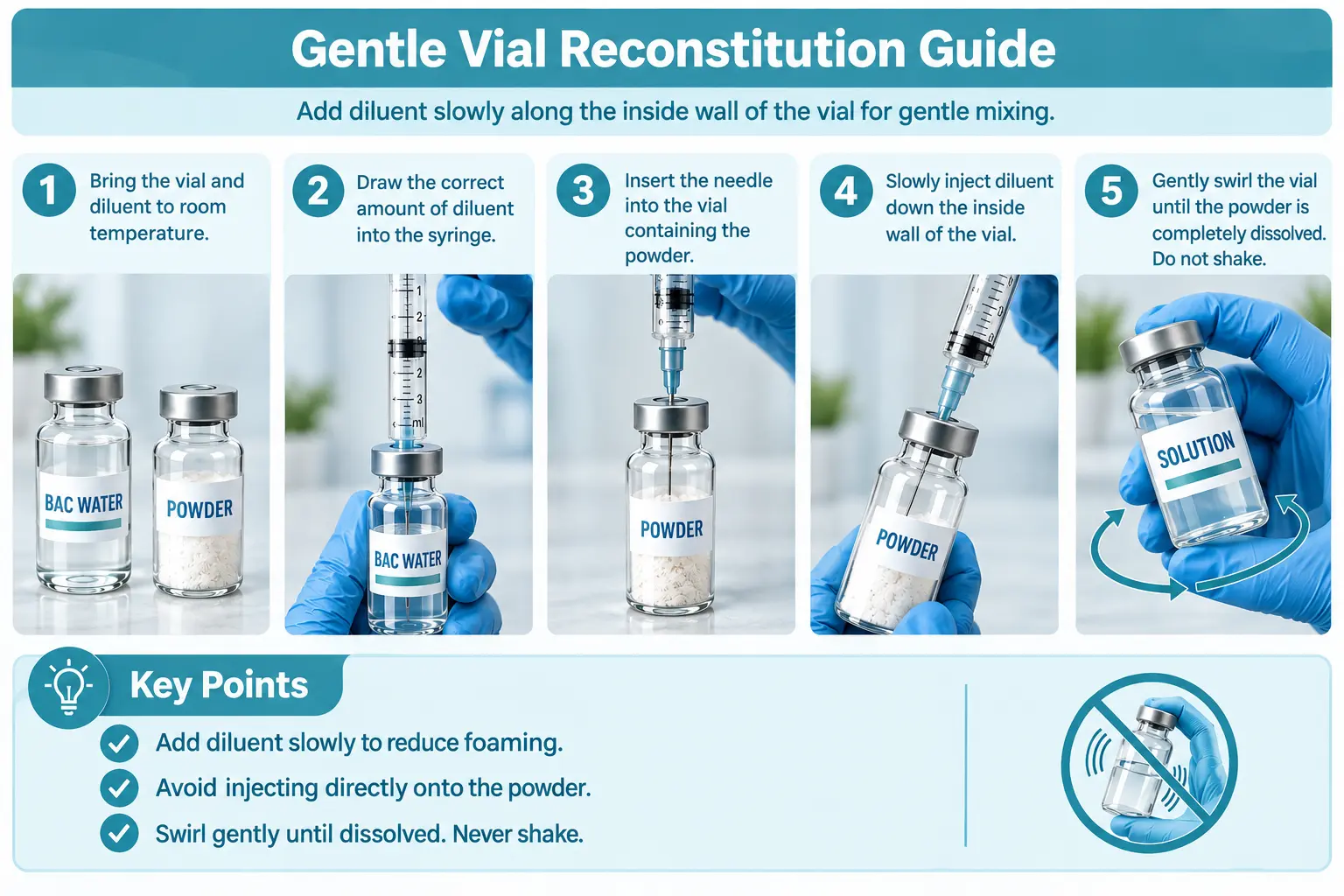
Follow the five steps in the guide above. Bring the vial and the diluent to room temperature first, add the bacteriostatic water slowly down the inside wall so it does not foam and swirl gently until the powder is fully dissolved. Never shake the vial and never spray the bacteriostatic water straight onto the powder.
Once it is mixed, the vial goes back in the refrigerator at 2 to 8°C (35.6°F to 46.4°F) and stays there until you have used it. Write the mixing date on the vial so the clock is visible, not remembered.
Unmixed powder is far easier to store. Keep it dry, out of light, at room temperature for short periods or at -20°C for the long term and reconstitute only what you plan to use.
Please log in to write GHK-CU 50mg review.
Manufacturer: Dragon Pharma, Europe
Pharmaceutical name: Testosterone Propionate,
Drostanolone Propionate, Trenbolone Acetate
Pack: 10 ml vial (150 mg/ml)
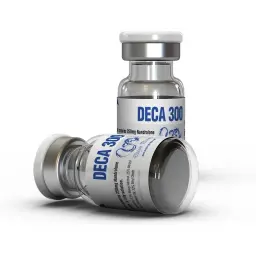
Manufacturer: Dragon Pharma, Europe
Pharmaceutical name: Nandrolone Decanoate
Pack: 10 ml vial (300 mg/ml)
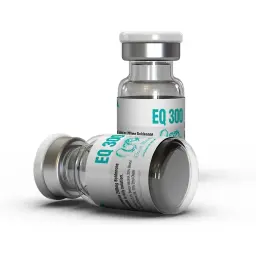
Manufacturer: Dragon Pharma, Europe
Pharmaceutical name: Boldenone Undecylenate
Pack: 10 ml vial (300 mg/ml)
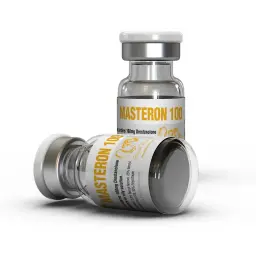
Manufacturer: Dragon Pharma
Pharmaceutical name: Drostanolone Di-Propionate
Pack: 10 ml vial (100 mg/ml)
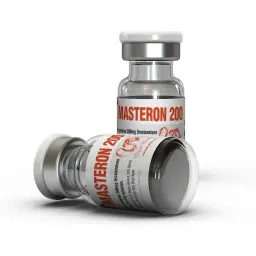
Manufacturer: Dragon Pharma, Europe
Pharmaceutical name: Drostanolone Enanthate
Pack: 10 ml vial (200 mg/ml)
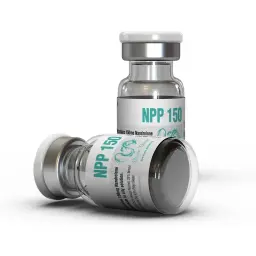
Manufacturer: Dragon Pharma, Europe
Pharmaceutical name: Nandrolone Phenylpropionate
Pack: 10 ml vial (150 mg/ml)
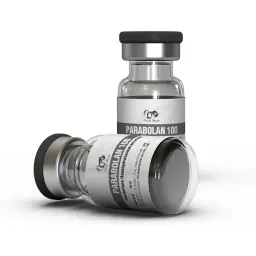
Manufacturer: Dragon Pharma
Pharmaceutical name: Trenbolone Hexahydrobenzylcarbonate
Pack: 10 ml vial (100 mg/ml)
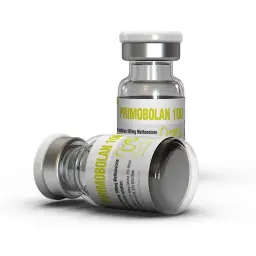
Manufacturer: Dragon Pharma
Pharmaceutical name: Methenolone Enanthate
Pack: 10 ml vial (100 mg/ml)