
Liraglutide vs Semaglutide: Weight Loss, Dosing & Cost
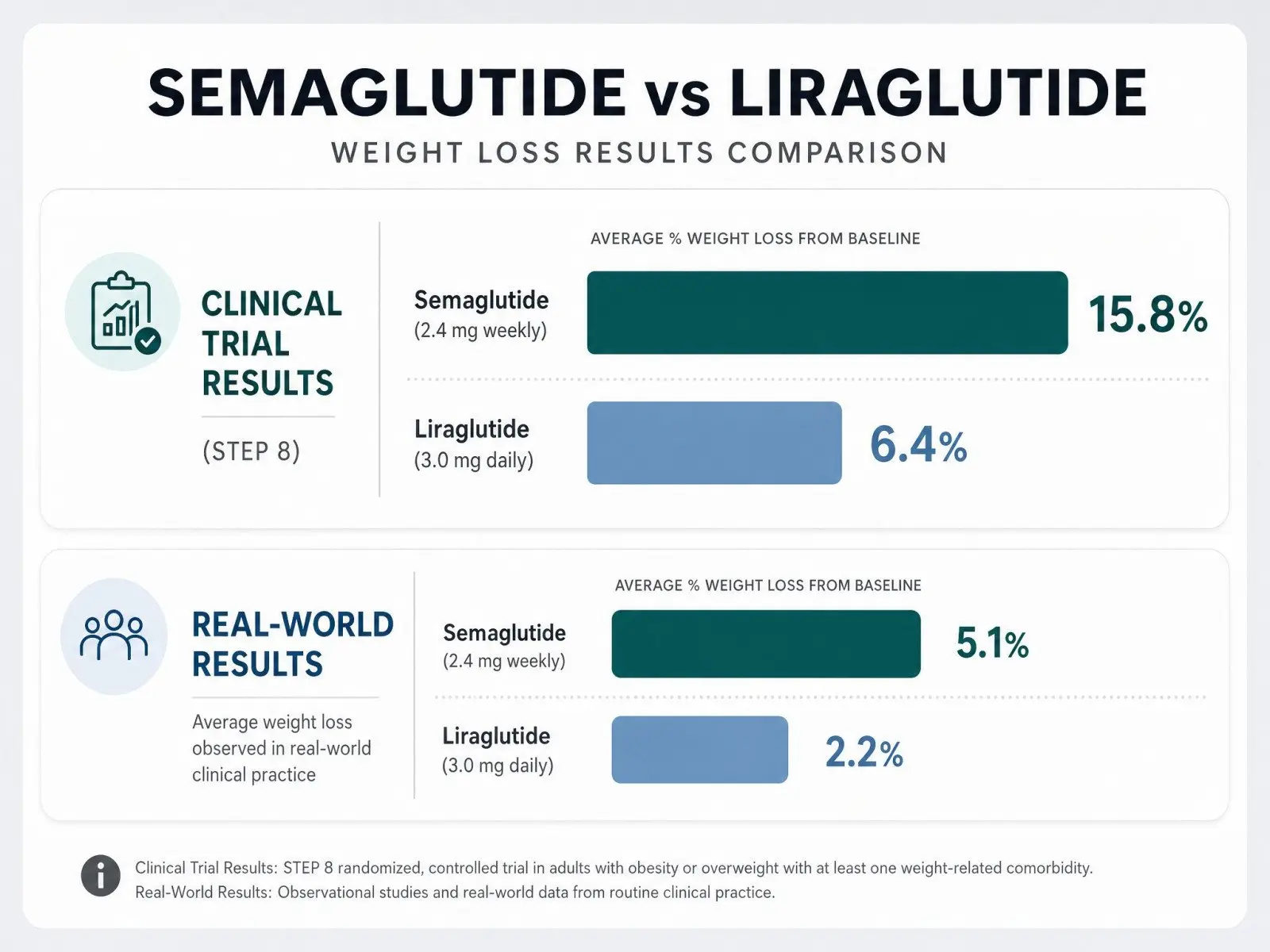
Quick answer: Semaglutide generally produces more weight loss and asks less of you day to day — once weekly instead of once daily. In the head-to-head STEP 8 trial, semaglutide 2.4 mg weekly produced 15.8% mean weight loss over 68 weeks versus 6.4% for liraglutide 3.0 mg daily. Liraglutide still works, just more modestly, and stays in the conversation for tolerability, titration flexibility, or coverage reasons. Neither is right if you can't tolerate the GI effects or afford to stay on it.
They're both GLP-1 receptor agonists, so they're related — but not the same drug, and not interchangeable. The messier question is what matters more for your actual life, not the fantasy version where you never miss a dose, never feel nauseated, and your insurer says yes with a smile.
Is liraglutide the same as semaglutide?
No. They're two different molecules in the same drug class. Both are GLP-1 receptor agonists that mimic the gut hormone glucagon-like peptide-1, and both change hunger, fullness, and stomach emptying. But they differ in structure, in how long they last in the body, in dosing frequency, and in how much weight people lose on them.
The brand names make this needlessly confusing:
- Semaglutide → Wegovy (chronic weight management), Ozempic (type 2 diabetes), Rybelsus (oral, diabetes)
- Liraglutide → Saxenda (chronic weight management), Victoza (type 2 diabetes)
- Wegovy and Ozempic are not interchangeable — different strengths, pens, and approved uses
- Same for Saxenda and Victoza
| Category | Semaglutide | Liraglutide |
|---|---|---|
| Weight-management brand | Wegovy | Saxenda |
| Schedule | Once weekly | Once daily |
| Half-life | About 7 days | About 13 hours |
| Typical trial weight loss | Higher — often 12–16% | Lower — often 5–8% |
| Main tradeoff | Stronger results, often more GI trouble | Milder results, daily injections |
Which leads to more weight loss?
This is where the gap stops being theoretical.
The cleanest head-to-head data came from the STEP 8 trial, comparing semaglutide 2.4 mg weekly with liraglutide 3.0 mg daily in adults with overweight or obesity without diabetes. After 68 weeks, the semaglutide group lost about 15.8% of body weight on average, versus 6.4% for liraglutide. That isn't a tiny edge — it's a real separation, and a 2025 meta-analysis of randomized trials found the weekly option also beat daily liraglutide for HbA1c and fasting glucose.
Real-world research shows the same ranking with smaller numbers. In a one-year comparative study in JAMA Network Open, average body weight change was roughly −5.1% for semaglutide and −2.2% for liraglutide. Less glamorous — because real life is.
Persistence matters more than people admit. A medicine that works beautifully in the abstract doesn't help if someone quits after six weeks because the nausea is rough or the co-pay is brutal. That's one reason weekly dosing often wins outside the lab: less friction. Though not universally — some people find a daily shot creates useful accountability and keeps the plan front of mind.
How they work
Both act like glucagon-like peptide-1, a gut hormone your body already releases after eating. That signalling helps the brain register fullness, slows stomach emptying, and affects insulin and glucagon — which is why both drugs started in diabetes care before becoming major obesity treatments.
They are not stimulants and not fat burners. They work upstream, mainly by changing how much food feels necessary or appealing. For many people the biggest change isn't a rush of energy — it's the quieting of food noise. Less grazing, less of that 9:30 p.m. mental negotiation where your brain pitches toast, cereal, and something sweet as if you've never been fed.
The schedule difference comes down to half-life: semaglutide persists about 7 days, liraglutide closer to 13 hours. The longer half-life is convenient, but cuts both ways — a rough wave of nausea on the weekly drug doesn't vanish overnight, while liraglutide clears faster, making dose adjustments feel more nimble.
Dosing schedules compared
A lot of "this drug didn't work for me" stories are really "I went up too fast," "I missed doses and restarted badly," or "nobody told me the first month is a build-up, not the main event."
Missed doses
Not something to freestyle. For Wegovy, if the next dose is more than 48 hours away, the missed dose can usually be taken as soon as possible; if less than 48 hours away, skip it and resume the regular schedule. If more than two weeks have been missed, many clinicians want a reset conversation, because restarting at the same strength can bring back stronger GI effects. For Saxenda, skip a missed daily dose and take the next at the usual time — don't double up. If you stop for more than three days, your prescriber may restart you at a lower dose.
Compounded liraglutide: where things stand now
Compounded GLP-1s became a huge market during the shortage years, at roughly $150–300 a month against $1,000+ for brand-name. That pathway has been closing, and the picture changed significantly in 2026 — so this is the section most likely to be out of date wherever else you read it.
The mechanics matter here. Under section 503B, outsourcing facilities generally can't compound from bulk drug substances unless the substance is on the 503B bulks list or the finished drug is on the FDA's shortage list at the time. Both doors are now closing.
On 30 April 2026, the FDA proposed excluding semaglutide, tirzepatide and liraglutide from the 503B bulks list, having found no clinical need for outsourcing facilities to compound them from bulk substances. Notably, the agency's framework asks whether something about the approved product makes it medically unsuitable for certain patients — and the FDA has been explicit that affordability and insurance access don't count as clinical need. That's the crux of the dispute.
Liraglutide's position has also been slightly different from the other two: because liraglutide injection remained on the shortage list into 2026, the shortage pathway hadn't fully closed for it at the same moment it closed for semaglutide and tirzepatide. That's a technical distinction, not a green light, and it can change without much warning.
The practical read for patients: 503A patient-specific compounding still exists, but it can't legally replicate the industrial scale that made compounded GLP-1s cheap and ubiquitous, and "essentially a copy" of an available approved drug isn't compoundable. Meanwhile the FDA has sent dozens of warning letters to compounders and telehealth sellers, and has rejected the workaround of adding B12 or amino acids to claim a product is "personalized." If you're buying something marketed as compounded liraglutide from an online seller, the quality and legal questions deserve at least as much attention as the price.
Side effects and safety
The most common side effects for both are gastrointestinal: nausea, vomiting, diarrhea, constipation, indigestion, bloating, reflux, abdominal pain. The first few weeks are the loudest. Semaglutide often causes more intense GI trouble because it's generally more potent — a 2025 efficacy and safety review found its weight-loss advantage came with a higher burden of GI adverse effects.
Practical habits help more than people expect: smaller meals, less greasy food, slower eating, better hydration. Eat like you're trying not to provoke the medicine — because you are.
A 2025 safety analysis suggested slightly different real-world profiles, with more gallbladder disorder reports linked to liraglutide and more vomiting tied to semaglutide. Not a reason to panic — a reminder that "same class" doesn't mean "same experience."
When to stop
Seek urgent care for severe stomach pain that won't let up, repeated vomiting, signs of dehydration, trouble breathing, facial swelling, or symptoms suggesting pancreatitis or serious allergic reaction. Separately, there's the effectiveness question: with Saxenda, clinicians often reassess after 16 weeks; with Wegovy, after a few months at maintenance. If the scale has barely moved, side effects are constant, and quality of life is worse — stubbornness is not a treatment plan.
Switching, combining, and cost
Switching: common. Combining: no. Using two GLP-1s together raises overlapping side effects without a magical double benefit. More nausea is not a strategy. The same applies to adding tirzepatide, which acts on both GIP and GLP-1 pathways — combining it with either drug isn't standard practice.
When switching, you generally stop one and start the other on a fresh titration plan, often at a lower starting dose even if you were on a high dose of the first. That feels like starting over because it partly is — the schedules aren't equivalent, and your stomach doesn't care about your impatience. Do it with a clinician, not by stacking leftover pens in your fridge.
On cost: both brand-name treatments can be expensive without insurance, and coverage varies wildly — some plans cover anti-obesity medications, some don't, many require prior authorization or documentation of prior attempts. A 2025 review of weight management guidelines notes these drugs are typically used in adults with BMI 30+, or 27+ with weight-related conditions. Ask about benefits before you get emotionally attached to a prescription.
One more factor that can shift the decision: if you have established cardiovascular disease, semaglutide has interest beyond the scale, since the SELECT cardiovascular outcomes trial showed a reduction in major cardiovascular events in adults with overweight or obesity and existing cardiovascular disease, even without diabetes.
Frequently asked questions
Is liraglutide the same as semaglutide?
No. They're different molecules in the same class (GLP-1 receptor agonists). Semaglutide lasts about 7 days and is dosed weekly; liraglutide lasts about 13 hours and is dosed daily. Semaglutide generally produces more weight loss.
Which is better for weight loss, liraglutide or semaglutide?
Semaglutide, on the evidence. In the head-to-head STEP 8 trial it produced 15.8% mean weight loss over 68 weeks versus 6.4% for liraglutide. Liraglutide remains reasonable where tolerability, titration flexibility, or insurance coverage favour it.
Is compounded liraglutide legal?
It's in flux. The compounding pathway rested on shortage status, and on 30 April 2026 the FDA proposed excluding liraglutide (along with semaglutide and tirzepatide) from the 503B bulks list, finding no clinical need. That proposal isn't final — the comment period was extended to 30 July 2026. Patient-specific 503A compounding still exists but can't replicate the previous scale, and a compounded copy of an available approved drug generally isn't permitted.
Can you switch from liraglutide to semaglutide?
Yes, and it's common. You typically stop one and begin the other on a new titration schedule, often starting lower than your previous dose. The schedules aren't interchangeable, so this should be managed by a prescriber.
Is Wegovy the same as Ozempic?
Both contain semaglutide, but they aren't interchangeable products. Wegovy is approved for chronic weight management; Ozempic is approved for type 2 diabetes. Different pens, strengths, and intended use. Saxenda and Victoza have the same relationship for liraglutide.
Which has worse side effects?
Both are dominated by GI effects, but semaglutide tends to bring more intense ones because it's more potent. Real-world reporting suggests more gallbladder issues with liraglutide and more vomiting with semaglutide.
The bottom line
For most people asking "liraglutide vs semaglutide" with weight loss as the goal, semaglutide is the stronger tool — roughly two and a half times the weight loss in head-to-head data, with the practical advantage of weekly rather than daily injections. Liraglutide isn't obsolete; it's the reasonable choice when tolerability, a more adjustable daily plan, or coverage points that way.
The unglamorous truth underneath both: the best medicine is the one you can actually get, tolerate, and keep taking. And with the compounded market closing, the affordability question that pushed so many people toward compounded versions hasn't been solved — it's just been moved.
This article is for educational purposes only and is not medical advice. Semaglutide and liraglutide are prescription medications with boxed warnings; suitability, dosing, and monitoring are decisions for a qualified prescriber. Regulatory information on compounded GLP-1s reflects the position as of publication in July 2026 and is subject to change — verify current FDA guidance before acting on it.